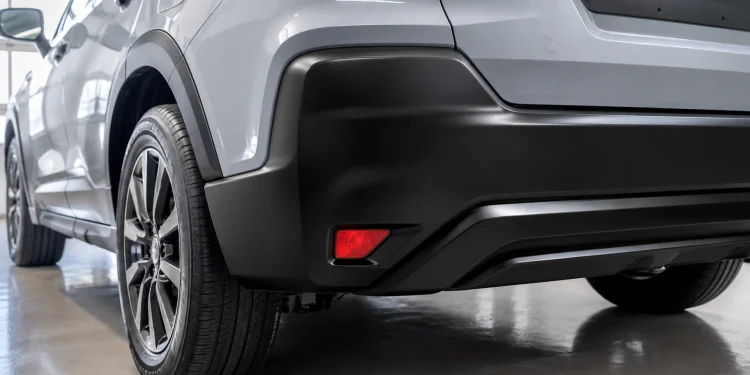
Renewing the interior and exterior plastics of a car is a matter of protection, smart maintenance, and preventing premature aging. And above all, it’s not a job to be done haphazardly. It requires a precise, step-by-step procedure, just as detailing professionals do.
In this guide, we'll go over exactly what to do: from deep cleaning with specialized cleaners to choosing the most suitable restoration product—whether natural, glossy, or intensive.
Ready to make your car's plastic parts look like new again? Let's start with the basics.
Why do automotive plastics fade and age?
Plastics don't "die" overnight. They deteriorate slowly, almost silently. At first, they lose their luster. Then they become dull. Finally, they fade to that dull gray that makes the car look older than it really is.
But what's really going on?
The first enemy is the sun. Ultraviolet rays penetrate the plastic surface and break the molecular bonds of the polymers. It’s an invisible but constant chemical process. Over time, the plastic loses its elasticity, dries out, and changes color. That’s why the most exposed parts (bumpers, trim, spoilers, and mirrors) are always the first to fade.
Then there’s water. Raindrops that dry in the sun leave behind mineral deposits. Those small spots that seem harmless actually seep into the micro-pores of the plastic. Add smog, dust, and road grime, and the damage is done.
Inside, however, the problem is different but just as serious. The plastics on the door panels are among the most heavily stressed. We touch them constantly. The dashboard is subject to the greenhouse effect inside the cabin. Heat builds up, amplifying the effects of UV rays.
And do you know what the most common mistake is? Thinking that all you need to do is “wipe a polishing product” over the dirt. In reality, without a deep clean, the result is only temporary. It’s like putting makeup on a dirty surface: you cover it up, but you don’t fix it.
For this reason, every professional refurbishment always begins with a crucial step: technical cleaning.
Difference Between Indoor and Outdoor Plastics
Not all plastics are the same. And treating them all the same is one of the most common mistakes.
Interior plastics are generally softer, often textured, and designed to feel pleasant to the touch. They must withstand constant contact, hand sweat, mild cleaning agents, and the heat inside the vehicle. However, they are not directly exposed to heavy rain, extreme temperature fluctuations, or heavy road grime.
Outdoor plastics, on the other hand, face much harsher conditions. They are subjected to:
- Direct sunlight for hours
- Acid rain
- Road salt
- Harsh car wash detergents
- Insects and Organic Waste
- High-Pressure Washers
Do you understand the difference?
A water-based protective coating with a natural finish may be perfect for the dashboard, but it might not be enough for a bumper that has been completely bleached by the sun.
That is why, in professional practice, we distinguish between:
- Cleaning method appropriate for the type of dirt
- Renovation product selected based on the severity of deterioration
- Desired finish (natural or glossy)
- Required Level of Protection
It's kind of like choosing a face cream: you wouldn't use the same formula for the eye area and for your body, right?
The same applies to the plastics in cars.
Before You Begin: A Complete Step-by-Step Guide to Replacing Car Plastic Parts
Here's the ultimate professional routine:
Step 1: Thorough Cleaning
- Choose Pulimax (interior) or APC (interior/exterior).
- It sprays.
- Work with a brush.
- Remove residue.
Step 2: Rinsing and Drying
- Rinse if necessary.
- Dry with a clean microfiber cloth.
- Make sure it is completely dry.
Step 3: Applying the protective coating
- Choose the right product.
- Apply with a pad or microfiber cloth.
- Spread evenly.
Step 4: Finishing Touches
- Remove excess.
- Check it against the light.
- Apply a second coat, if necessary, after one hour.
Simple, yet professional.
The golden rule: deep cleaning before renovation
There's no room for compromise here. No restoration product will work properly if applied to a dirty surface.
Dirt gets trapped in the micro-pores of the plastic. Even when it looks clean to the naked eye, it’s actually still contaminated. If you apply a dressing directly on top of it, this is what happens:
- The product does not adhere properly
- The finish is uneven
- The lifespan is drastically reduced
- Dark circles may appear
Professional cleaning always involves a specific cleaner and mechanical scrubbing with a brush. The brush is essential because it allows the foam to penetrate the plastic’s texture.
After working the cleaner into the surface, rinse it off (if necessary) and dry it thoroughly with a clean microfiber cloth.
The protective coating can be applied only after the surface is completely dry.
Remember this sequence as if it were a mantra:
- Thorough cleaning with APC or a specialized cleaner
- Mechanical action with a brush
- Removal of Residues
- Complete drying
- Application of the renewal product
Simple? Yes. But it has to be done right.
Interior Cleaning with Pulimax: A Professional Method

When it comes to professional car interior cleaning, Pulimax is one of those products that really makes a difference. For example, it’s a must-have for cleaning the steering wheel—one of the car parts most prone to dirt, wear, and bacteria.
It's not just a simple cleaner. It's a ready-to-use formula that works deep down on:
- Fabrics
- Skai
- Plastics
- Mats
Its active foam penetrates deep into the fabric, dissolves stubborn dirt, and neutralizes odors at the source. It doesn't just mask them. It eliminates them. And that's a huge difference.
The adjustable spray nozzle is a feature that many people underestimate, but it actually affects both precision and cost savings. Proper dosing helps avoid waste and unnecessary saturation.
Correct procedure:
- Spray a small amount of the product onto the surface.
- Let it sit for a few minutes.
- Work with a soft-bristled brush until a lather forms.
- Wipe it off with a clean, dry microfiber cloth.
For stubborn stains, repeat the treatment. No need to dilute. It's ready to use.
Pulimax is also biodegradable and is chosen by car wash professionals precisely because of its effectiveness and speed.
And the best part? It revives the faded colors of fabrics and interior plastics, restoring their luster without leaving streaks.
A perfect base before any protective treatment.
Multi-surface cleaning with All-Purpose Cleaner (APC)

All-Purpose Cleaner – Maniac Line for Car Detailing
While Pulimax is perfect for ready-to-use interior cleaning, the All Purpose Cleaner from the Maniac Line is the technical tool that every enthusiast or professional should have in their garage. Why? Because it’s versatile, concentrated, and customizable. Basically, you adapt it to the situation.
An APC is not just a simple detergent. It is a multi-surface cleaner capable of dissolving both organic and inorganic dirt: insect residue, smog, dust mixed with grease, and tough stains on plastics and carpets. Its highly concentrated formula allows you to choose the dilution ratio based on the type of cleaning task.
And that's the advantage.
For interior surfaces (plastics, fabrics, carpeting), the recommended dilution ratio is 1:5. This means one part product to five parts water. This creates an effective yet safe cleaner that’s also perfect for routine cleaning of Alcantara.
For exterior surfaces such as wheels or the engine compartment, you can increase the concentration using a 1:1 or 1:3 dilution, while for pre-washing to remove insects, you can go as high as a 1:20 dilution.
The procedure is simple but must be performed with precision:
- Dilute properly.
- Apply to a cool surface.
- Work with a brush or soft-bristled brush until a lather forms.
- Wipe with a microfiber cloth or rinse (for rims, use a pressure washer).
- Dry thoroughly.
Watch the video and learn how to use it right away:
A key feature: APC neutralizes odors on contact, without masking them with overpowering fragrances. It leaves a neutral, clean scent.
This is the ideal product when the outer plastic surfaces are heavily contaminated before applying a protective coating. Remember: if the micropores aren't clear, the dressing won't adhere.
A well-used APC is like a canvas that's been perfectly prepared before painting. Without this step, the final result will never look truly professional.
The Right Tools for Perfect Results
Do you know the difference between a job that's done and a job that's done well? The tools.
You can have the best cleaner or the best protective product on the market, but if you apply it with low-quality tools, the result will be mediocre. It's like cooking with excellent ingredients using a worn-out pan.
Let’s start with soft-bristle brushes. They’re essential for working cleaning agents like Pulimax or APC into the texture of plastic surfaces. The bristles need to be gentle but sturdy enough to provide mechanical action. The goal isn’t to scratch the surface, but to dislodge dirt from the micropores.


Lime Brush
Then there are microfiber cloths. Not just any microfiber cloth. They must be clean, soft, and designated for that specific use. Microfiber has an extraordinary ability to trap dirt and product residue without leaving streaks.
The following factors come into play when applying protective coatings:

Microfiber Pad

The Microfiber Pad allows for controlled and even application, making it ideal for products like All Round Plastic Protectant. The Foam Pad is perfect for sprays like Faspoiler, as it helps distribute the product without waste.
And then there's a simple but essential rule: don't use the same cloth for cleaning and polishing. You risk transferring residue and compromising the finish.
In car detailing, the quality of the accessories is half the battle. It's not just a detail. It's a strategy.
Drying: the step that many people underestimate
How often do you see a protective coating applied to plastic that's still slightly damp? Way too often.
Moisture is the silent enemy of adhesion. If the surface isn’t completely dry, the restoration product won’t bond properly to the plastic. The result? Reduced durability, an uneven finish, and possible stains.
After cleaning with Pulimax or APC, you must:
- Remove all the foam.
- Wipe it down with a dry microfiber cloth.
- Make sure there are no damp spots left in the grooves or weaves.
Here's a little pro tip: look at the surface against the light. If you see darker areas, they may still be damp.
Don't rush. Waiting a few extra minutes can make the difference between a job that lasts three washes and one that lasts much longer.
Remember: The plastic must be dry, clean, and cool before applying the protective coating.
It is the foundation for consistent, long-lasting results.
All Round Plastic Protectant: Protection and a Natural Finish

All-Round Plastic Protectant – Maniac Line for Car Detailing
When it comes to comprehensive protection for interior and exterior plastics, All Round Plastic Protectant is an extremely versatile solution.
Its water-based, pH-neutral formula isn't greasy, leaves no oily residue, and enhances the original color without making it overly shiny. It's perfect if you want a natural look, as if the plastic were simply "new" and untreated.
One of its key features is Anti-UV™ Technology, which blocks ultraviolet rays to prevent fading and cracking. It's like applying sunscreen to your car's plastic parts.
You can adjust the finish depending on the dilution:
- 1:1 for faded and worn interior plastics.
- Use undiluted for heavily worn exterior plastics.
- 1:2 for a natural and subtle look.
Correct procedure:
- Clean and dry the surface thoroughly.
- Apply the product to a microfiber pad.
- Spread evenly.
- Wipe it down with a clean cloth.
- If necessary, repeat after one hour (especially on porous plastics).
Watch the video and learn how to use it right away:
The product repels water and dirt, reducing the need for frequent cleaning. It lasts for an average of three or four washes.
It's ideal for:
- Dashboards
- Door panels
- Exterior trim strips
- Engine Compartment Plastics (after cleaning with APC)
A smart, balanced, professional protective product.
Protection of Engine Compartment Plastics
The engine compartment is a sensitive area. It’s not just dirty—it’s contaminated with grease, industrial dust, and oily residues. Before applying any protective treatment, it must be thoroughly cleaned with APC.
The recommended procedure is:
- Proper dilution (1:1 or 1:3).
- Apply at a distance of about 20 cm.
- Brushwork.
- Removal with a microfiber cloth.
It is important not to damage safety labels or color-coded markers. Thorough cleaning clears the micropores and allows the protective coating to adhere properly.
Only after this step should you apply All Round Plastic Protectant, spreading it carefully and finishing without using too much.
The result? Smooth, protected, and visually appealing plastic components in the engine compartment.
A detail that really makes a difference.
Diamant Plast Dressing Pro: Glossy, Protective Finish

Diamant Plast Dressing Pro
If you love that deep, glossy, almost “wet” look, then Diamant Plast Dressing Pro is the product that completely transforms the visual impact of plastic surfaces. We’re not just talking about protection here, but about a bold aesthetic. It’s the perfect choice when you want your plastic surfaces to stand out, catch the light, and look like they’ve just come out of a showroom.
Its formula combines carnauba wax and hydrophobic synthetic polymers. Carnauba wax is renowned for its resistance to weathering and abrasion. It is a natural wax also used in the best car body polishes, precisely because of its ability to create a long-lasting protective barrier. The synthetic polymers, on the other hand, have a self-leveling effect: the product spreads evenly, preventing spots and streaks.
The result is a surface:
- Shiny but even
- UV-protected
- Dust-proof
- Not greasy
- Water-resistant
It's ideal for interior and exterior plastics, rubber, and vinyl. You can use it on dashboards, door panels, moldings, trim, wheel wells, and even the plastics in the engine compartment.
Correct procedure:
- Shake the product well.
- Apply a small amount from a distance of about 20 cm.
- Wipe it down with a clean microfiber cloth.
- Finish by trimming off any excess.
- Don't use too much: it's concentrated.
Watch the video and learn how to use it right away: Renew, polish, and protect your car's plastic parts with the best product, Diamant Plast Dressing Pro
A common mistake is applying too much, thinking it will make it last longer. In reality, using too much causes buildup and can attract dust. It’s better to use a small amount and spread it evenly.
Diamant Plast Dressing Pro dries quickly, leaves a pleasant scent, and does not discolor plastics. The effect lasts for weeks and withstands washing.
This is the right product when you want a bolder look than the natural finish of a water-based protective coating.
Faspoiler: A powerful solution for severely faded exterior plastics
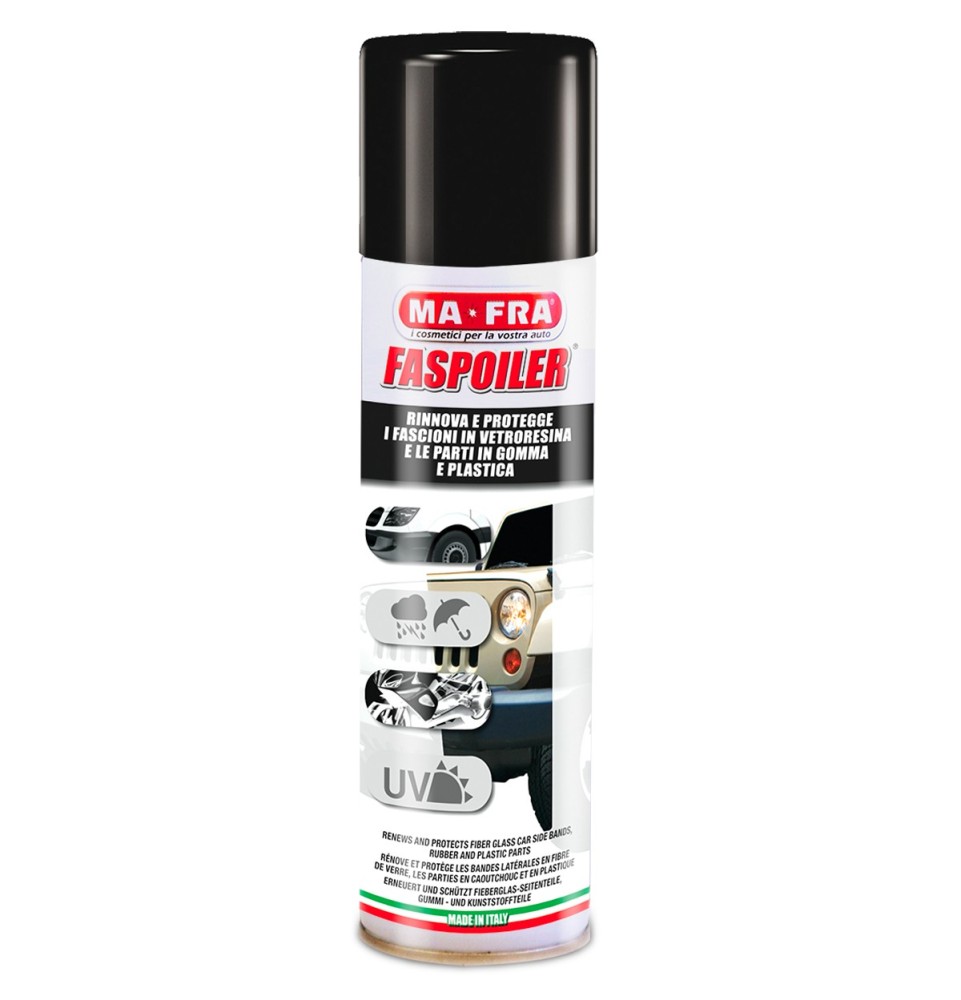
There are situations where exterior plastics have faded so badly that a traditional product struggles to restore them to their former condition. That's where Faspoiler comes in.
This is a solvent-based, ready-to-use spray designed for more intensive applications. It is particularly suitable for:
- Bumper
- Side panels
- Spoiler
- Capote
- Plastic and rubber parts that are highly exposed
Its formula, rich in polymeric substances, creates a transparent, glossy, protective film that adheres immediately to the surface. The effect is instantaneous. In just a few seconds, the color deepens, and the plastic regains its depth and uniformity.
Compared to water-based products, Faspoiler has a more intense effect precisely because it contains solvents that help restore heavily oxidized plastics. It’s the solution when you’re “struggling a bit” with gentler products.
Correct procedure:
- Shake the can vigorously.
- Spray from a distance of about 20 cm.
- Spread it out with a foam pad to even it out.
- Repeat this periodically to maintain protection.
Watch the video and learn how to use it right away: How to Restore Your Car’s Plastic and Rubber Parts – Do-It-Yourself – Classic Cars by #MAFRA
The product is non-greasy and is resistant to the effects of hot or cold water, sunlight, and dust over time. When used regularly, it prevents discoloration and aging of exposed parts.
It's the ideal choice when you want quick, professional, and visually noticeable results on severely damaged exterior plastic parts.
Product Comparison: Which One Should You Choose?
Choosing the right product doesn't mean picking "the absolute best," but rather the one best suited to the situation. Let's look at a practical comparison.
| Product | Type | Finish | For indoor use | External use | Renewal Intensity | Home |
| Pulimax | Detergent | — | ✔ | — | Cleaning | Ready to use |
| APC | Concentrated detergent | — | ✔ | ✔ | Deep Cleaning | Concentrate |
| All-Round Plastic Protectant | Protective | Natural and versatile | ✔ | ✔ | Medium | Water-based |
| Diamant Plast Dressing Pro | Dressing | Glossy | ✔ | ✔ | Medium-High | Wax + Polymers |
| Faspoiler | Spray Refresher | Intense shine | — | ✔ | High | Solvent-based |
When should you choose what?
- Want a natural, protective finish? Choose All Round Plastic Protectant.
- Do you love a glossy, shiny finish? Choose Diamant Plast Dressing Pro.
- Do you have exterior plastic parts that are very faded? Choose Faspoiler.
- Do you need to clean thoroughly first? Choose Pulimax or APC.
The rule is always the same: clean first, then protect.
How long do treatments on plastics last?
On average, these products last for at least three or four washes. But their actual lifespan depends on several factors:
- Sun Exposure
- Washing Frequency
- Types of detergents used
- Application Quality
- Possible second coat
Exterior plastics are exposed to more extreme conditions, so they may require more frequent maintenance than interior plastics.
A professional tip? It's better to do light but regular maintenance than to wait until the plastic has completely faded.
Prevention is always easier than recovery.
Common Mistakes When Replacing Car Plastic Parts
Even with excellent products, mistakes can ruin everything.
Here are the most common ones:
- Apply the protective coating without deep cleaning.
- Using too much product.
- Working in direct sunlight.
- Do not buff with a clean microfiber cloth.
- Failure to follow the APC dilution instructions.
- Apply to a surface that is still damp.
Every mistake reduces the durability and quality of the finish.
Detailing isn't complicated, but it does require a systematic approach. It's a precise sequence of steps. If you skip a step, the result will suffer.
Professional Tips for Long-Lasting Results
Do you really want to make a difference? Then keep these points in mind:
- Don't wait until the plastic is completely gray.
- Protect your skin before summer.
- Avoid using detergents that are too harsh in subsequent washes.
- Keep the surface clean by wiping it down lightly on a regular basis.
- Apply a second coat to the areas that are most worn.
The door panels and dashboard are among the parts that undergo the most stress. The bumpers are the most exposed. Treat them with care.
Refreshing the interior and exterior plastics of a car isn't magic. It's a method. It involves deep cleaning followed by applying the right product the right way.
And when the plastic parts are dark, uniform, and protected again… the car takes on a whole new look. It looks younger. Better maintained. More vibrant.
There's no need to replace it. You just need to know how to fix it.
Frequently Asked Questions About Auto Plastic Replacement
-
How often should car plastic parts be replaced?
It depends on the exposure. On average, every 2–3 months for areas with high outdoor exposure, and every 3–4 months for indoor areas.
-
Can I use the same product indoors and outdoors?
Yes, products like All Round Plastic Protectant and Diamant Plast Dressing Pro are versatile. For very faded exteriors, Faspoiler is better.
-
Is it always necessary to dilute APC?
Yes, it must be diluted according to the surface area. That's the only way to ensure safety and effectiveness.
-
Is the treatment resistant to automatic car washes?
It can withstand multiple washes, but very harsh detergents may shorten its lifespan.
-
Can I apply the product while I'm out in the sun?
No. The surfaces must be cool to prevent too rapid evaporation and streaks.