Published on: 04/09/2024 Updated on: 20/02/2025
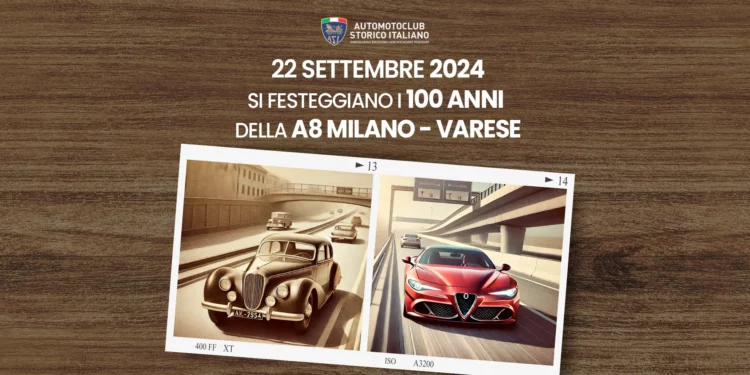
On September 21, 1924, the Milan-Varese, the world's first highway, was inaugurated. A century later, a procession of vintage cars, greeted by the unmistakable inflatable arch and the Mafra Welcome Kit, retraces it to celebrate its importance
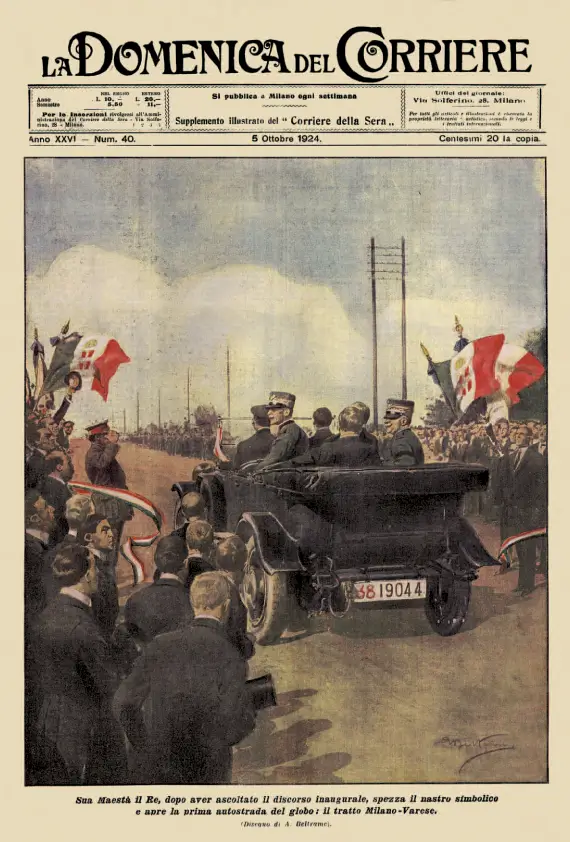
One hundred years and counting. In fact, a century has passed since Vittorio Emanuele III, King of Italy, inaugurated the Milan-Varese Highway on September 21, 1924. After cutting the ribbon, a procession of automobiles drove along the route, thus sanctioning the de facto birth of the world's first highway. At the head of the column was the Lancia Trikappa in which the sovereign traveled, driven personally by the designer of the work, engineer and entrepreneur Piero Puricelli.
 To celebrate this anniversary, theASI and the ASI Lombardi Federated Clubs, with the coordination of the CMAE of Milan, organize an event for classic cars and motorcycles of the period including between the 1920s and 1945.
An event that Mafra supports as a sponsor, celebrating the historic highway, whose route laps the company's headquarters in Baranzate (MI), near the Fiera Milano interchange.
Greeted by the large and unmistakable Mafra inflatable arch, event participants receive the Mafra Welcome Kit, containing valuable care products for their cars.
- Waterless is Mafra's innovative product that makes it possible to wash without water all the external parts of the car: it allows, therefore, to intervene in any situation, even during an event.
- Heavy Work is, on the other hand, the Mafra microfiber cloth, which can be used both to dry the bodywork on the outside and to remove dirt from the surfaces of the passenger compartment on the inside.
The event is sponsored by the Ministry of Infrastructure and Transport and Autostrade per l'Italia, and has the collaboration of the Lombardy Region.
Palazzo Lombardia was also home to an exhibition to celebrate the centenary of theLakes Highway, open from June 27 to July 26 last year. On display are photographs from the past, road signs, historic cars and vintage gas stations, the latter from the Fisogni Museum of Tradate (VA).
The centennial program of the Milan-Varese
On Sunday, September 22, a column of historic vehicles retraces the same route taken by the ancestors on September 21, 1924, going by highway from Milan and Varese.
A journey under the banner of pride in belonging to the Lombardy region, cradle of treasures in the world of motors, such as artisan enterprises, industries and brands of global significance.
The event begins at 8 a.m. with the gathering of historic cars and motorcycles in Milan at the Region's headquarters in Palazzo Lombardia.
At 10 a.m. the procession moves in the direction of Varese, escorted by the Milan Local Police to the entrance of theA8 Lakes Motorway. At that point the service is taken over by the State Police, who accompany the cars to their destination.
At 11:30 a.m. the column reaches Varese, where the cars are rearranged in Piazza della Repubblica, before being presented to the public, starting at 12 noon, in Piazza Montegrappa.
At 1 p.m., participants move to Villa Ponti Park (Piazza Litta 2) in Varese, where cars and motorcycles remain on display during lunch and the awards ceremony, scheduled to begin at 1:30 p.m.
The conclusion of the event is scheduled around 4 p.m.
Let's relive 90 years of the highway together through this video.
Milan-Varese highway: a fundamental work
It should not be forgotten that when theMilan-Varese Highway, later called the Autostrada dei Laghi, was inaugurated, there were less than 60,000 cars, about 30,000 trucks and no more than 2,500 coaches on the road in Italy.
Despite the paucity of potential users, foresight led Piero Puricelli to design a groundbreaking work. A Milanese entrepreneur and engineer, Puricelli had already built another seminal work in 1922, theMonza Autodrome.
In just over a year, the first 42-kilometer-long section of the Lakes Highway was completed.
We should not, however, imagine it as it is today, with the first section recently increased to five lanes in each direction. At that time, the Milan-Varese highway had only one lane in each direction and the route included 17 toll booths for toll collection.
One of the novelties, in fact, stemmed from the idea of repaying its cost, which amounted to 90 million liras, with self-financing obtained through the collection of the prescribed transit fare.
A tax that for cars varied according to horsepower and provided a 20 percent discount for round trips.
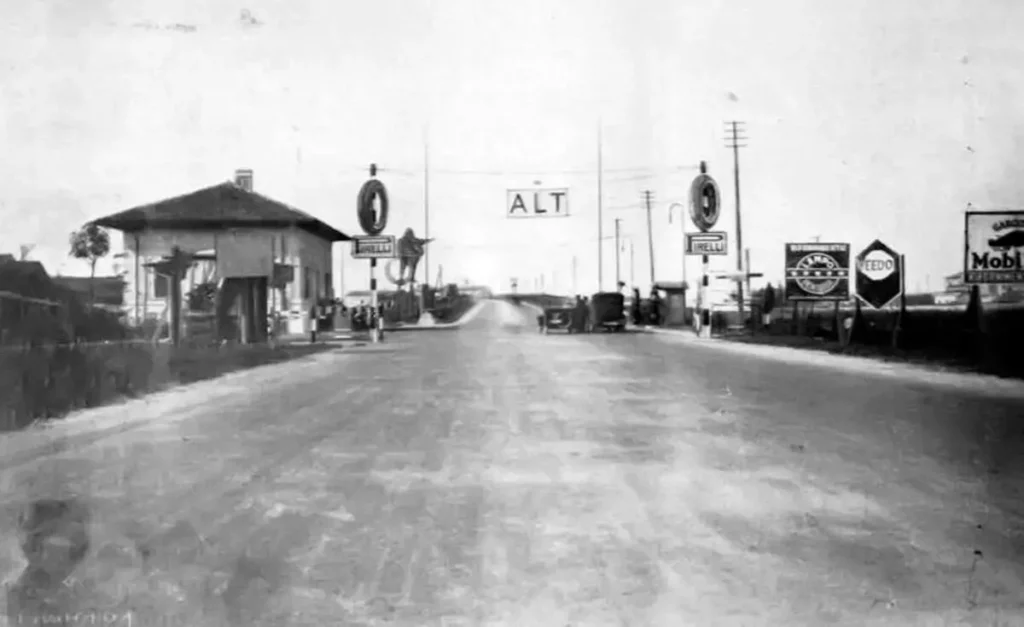 The effort to realize theMilan-Varese Highway, which today we call A8, had been impressive. They served, in fact, 4 thousand workers busy every day at the site with trucks, diggers, road rollers and special concrete mixers brought in from the United States.
More than 200 concrete structures, such as bridges and overpasses, were built along the route.
Continued growth
The first widening of theA8 highway dates back to 1925, when the 24-kilometer-long Lainate-Como (now known as the A9) branch was opened.
It was then the turn of the 11 kilometers between Gallarate and Sesto Calende, which made it possible to connect three lakes, the Maggiore, Como and Varese lakes.
The original route of the A8 highway remained single-lane until 1965, when it was doubled. In 1971, however, the continuation to the Brogeda customs post was completed, thus connecting Milan with Switzerland.
The growth of traffic throughout the Milan metropolitan area and the expansion since 2000 of Malpensa Airport have necessitated numerous upgrades.
 From 2005 the highway was equipped between the beginning and Lainate of four lanes in each direction, later to become five in the 2023.
Service areas in Lainate have also been renovated in recent years, most notably the Autogrill Villoresi Ovest. The service area includes an iconic arched structure, designed in 1958 by architect Angelo Bianchetti, similar to that which still characterizes the Los Angeles airport.
Mafra supports the centenary celebrations of theMilan-Varese highway, under the banner of passion for historic cars and great works of Italian ingenuity.