Published on: June 8, 2026 Updated on: June 8, 2026
How would you feel if one day, on the other side of the world, someone took your name, put it on a sign, printed it on a label, and presented themselves at the market as if they were “you”?
We’re not just talking about a word or a logo. We’re talking about identity, trust, and a journey built over time through hard work, choices, mistakes that were corrected, long nights, and goals achieved. When someone tries to “steal” all of this, they’re not just copying an image—they’re trying to steal your reputation.
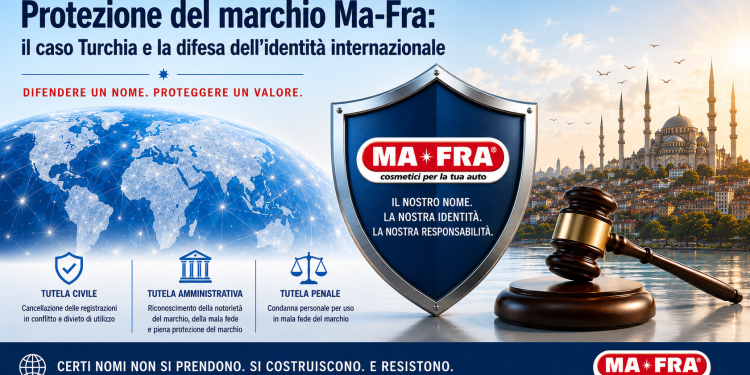
This is where the case involving Ma-Fra in Turkey began. It is a long and complex story that began in 2018 and concluded today with a decision that is rare in its clarity and strength—a complete victory on multiple levels: civil, administrative, and even criminal.
And this is precisely where the aspect that makes this result even more significant comes into play. The Ma-Fra trademark is registered and protected worldwide: a decision made long ago and consistently upheld to safeguard what our name represents in every market. In the Turkish case, however, the dispute did not concern an identical copy of the Ma-Fra logo, but rather a mark derived from our name, to which an additional term had been added: “Mafra Point.” Achieving a complete victory against a trademark of this type—one that does not reproduce the logo but nonetheless capitalizes on the strength and reputation of the Mafra name—is the most difficult feat in the realm of brand protection. And that is exactly what we have accomplished.
A choice rooted in a principle
When a trademark is used improperly, the temptation is often to just let it go. Because it costs money, because it takes effort, because the pace of the legal system doesn’t match that of business. And because, at some point, you ask yourself, is it really worth it?
But then a simple truth sets in: if you don't stand up for who you are, sooner or later someone else will use it in your place.
That is why Ma-Fra has chosen not to back down.
The crux of the matter: bad faith, laid out in black and white
In the civil proceedings, Turkish judges—up to the highest levels—recognized a key fact: whoever had registered and used “Mafra Point” had done so in bad faith. Not by chance, not because of an “accidental” resemblance, but knowingly.
The decisions paint a very clear picture:
- The individual was already aware of the existence and reputation of the Ma-Fra brand, in part due to previous dealings in the industry
- The disputed trademark had been registered for identical or very similar services
- The mark was confusingly similar, both visually and in terms of its overall meaning, because it was based on the name “Mafra” and was therefore likely to directly evoke that identity.
- The operation was intended to take unfair advantage of others' reputation and to create confusion in the market
Result: cancellation of the conflicting registrations and a prohibition on the use of the disputed trademark.
Simply put, the court looked at the facts and said “no.” You don’t do that, and it won’t fly.
The twist: not just a mistake, but a personal condemnation
Then comes the part that's truly surprising, because it's not at all predictable.
The criminal proceedings concluded with a personal prison sentence of 10 months and 4 days for the use of the trademark in bad faith, without any reductions or suspensions, in part due to the convicted person’s failure to show remorse.
An extremely rare outcome in local practice: a foreign company securing a criminal conviction in Turkey against a Turkish individual for the bad-faith use of a trademark.
Here, the story takes a different turn. It is no longer just a dispute over documents and records. It becomes a very clear message: intentionally misappropriating a brand’s identity is a serious matter, and it can have personal consequences.
Why This Story Affects Everyone
At first glance, this might seem like a topic “for insiders.” In reality, it’s about something very concrete: trust.
A brand is the symbol that embodies everything people recognize and remember: I trust it, it’s the real thing, it’s what I know. When someone causes confusion, they don’t just harm the company—they also harm partners, distributors, and customers—those who choose a product every day based on a specific identity.
Protecting the brand, therefore, is not a matter of pride. It is a responsibility to the market.
The conclusion: We must always defend what is valuable.
This case strongly confirms what Ma-Fra has built over the years: a trademark that is already registered and protected worldwide, and capable of holding its own even in the most complex cases—such as those in which the dispute does not concern an exact copy of the logo but rather a derivative name that attempts to capitalize on its strength.
And it sends a clear message for the future: anyone who tries to exploit a reputation built over decades of work will find neither silence nor shortcuts.Because certain names aren’t just “acquired.” They’re built. And when they’re genuine, they endure.