Published on: 27/04/2018 Updated on: 20/02/2025
The only existing Ferrari F40 giallo Modena restored to its original splendor by professional car detailing treatment #Labocosmetica
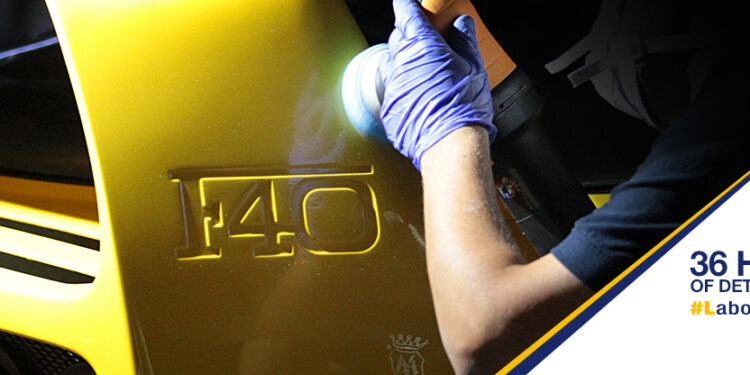
36 hours of painstaking work, witnessed by an emotional video. A unique car that, thanks to #Labocosmetica products and the experience and professionalism of the MAFRA detailing team, shined again as if it had just left the dealership.
The story of a myth
The Ferrari F40 is the embodiment of the ultimate car all to be "driven" and one of the best "pure and analog" supercars ever produced under the aegis of the "Drake," Enzo Ferrari, then still alive. The designer was Nicola Materazzi, the brilliant engineer who also made such sacred monsters as the GTO, the Testarossa, and the 288 GTO Evoluzione. The year was 1987: its iconic styling, explosive performance, and ruthless, legendary road manners experienced in the Modena area would make it one of the most coveted and admired Ferraris ever, so much so that from new hundreds of enthusiasts were lining up willing to do anything not to give up on what was shaping up to be the most incredible supercar of all time. It cost 347 million liras, but not a few people bought reservations and the related car on the parallel market for more than a billion. And the great thing is that it still proudly earns its "Pole" among the most sporty and desirable automotive myths, with quotations exceeding one million euros.
Built in 1311 examples and designed by Pininfarina to celebrate Ferrari's 40th anniversary, the F40 undoubtedly represents not only the pinnacle of performance in the 1980s, but is also distinguished by an astonishing modernity of line, beneath which lies the appropriately modified central body, with specific reinforcements in the central area of the sills, of the 308 GTB. A stainless legend, whose beating heart is a "sanguine" 2.9-liter with 478 hp at 7000 rpm and maximum torque of 58.8 kgm at 4000 rpm, developed on the basis of the 8-cylinder engine of the 288 GTO. Weighing just 1,088 kilograms, its performance is record-breaking: 324 km/h top speed and 0-100 km/h in 4.1 seconds, securing it a "gold standard" position even compared to supercars produced later.
All 1311 examples produced in about 5 years were offered in classic Rosso Corsa. The example subject of the car detailing, however, is very special because it was repainted in Giallo Modena and because it is the only Ferrari F40 to have an official document from Maranello certifying its approval for the color change. To present it at its best, the super sports car underwent a deep detailing treatment with #Labocosmetica professional products, expertly used by MAFRA's team of specialists.
The myth returns to shine
Car detailing always follows a precise pattern, and each procedure is scheduled on the worksheet and then shared with the customer. First, the car must be washed so that imperfections are not concealed. Detailing can be conducted according to various degrees of intervention, up to the maximum one that requires days of work and highly professional products. The treatment steps follow a "scientific" process to remove impurities without affecting other parts of the car.
Wheels
On the Ferrari F40, the decontamination of the rims and wheels from tar and dust residues caused by the brake pads was a very delicate operation because it was carried out without being able to disassemble the rims, as would be the practice. In fact, the single-nut fasteners on the F40's rims can only be unscrewed with special equipment, as is proper for 300-mph behemoths.
Prewash
After decontamination of rims and wheels, we proceed with pre-washing: before starting the shampoo and glove wash, a special substance that is capable of removing dirt must be used. In this case, the following was used #Neve, suitable for descaling and removing dirt so that residue does not cause problems during the next stage of washing.
Washing
Washing is done with #Semper, a neutral lubricating shampoo with high cleaning power and great safety of use. The washing technique used is the two-bucket technique: this is one of the safest systems to keep the vehicle at its best while minimizing the possibility of causing paint blemishes. Two gloves are also used so as not to transfer dirt from the bottom (usually more contaminated) to the top, creating additional flaws to prepare the paint for correction with polish cycle or sealant protection.
Decontamination
Chemical decontamination follows: certain types of contaminants have the ability to penetrate inside the pores of the paint and require special chemical action to be removed and to make the surface even cleaner. Basically, the result that cannot be achieved by washing is achieved by using #P-Ray e #Purify. In addition, the use of the Super Dryer microfiber cloth is important for proper drying. The chrome exhaust tips have been enhanced with. #Cronos, an effective decarbonizer that can make them like new again.
Now it is time for mechanical decontamination: sometimes it happens that imperfections are not visible to the naked eye. In this case, you need to pass the clay bar over the paint to remove all the impurities present even after washing and make the paint ready for polishing.
Inspection
Before proceeding with polishing treatments, inspection is a must. To perform it perfectly, one must help with a hot light source to bring out the defects on the bodywork. If they are present, the defects are entered on the work sheet so that the detailer can make an accurate and complete analysis of the work to be done.
Interior and engine
Of course, the manic attention to the aesthetics of the custom-built car does not escape the interior and engine. The cabin is first completely vacuumed with steam equipment and then thoroughly cleaned through specific solutions, such as All Porpuse Cleaner #APC, ideal for both fabrics and plastics. Carbon parts, on the other hand, are polished. At the end of the process, the seats are protected with Idrostop, a waterproofing agent that prevents the absorption of any stains. #APC is also the ideal solution for caring for the engine compartment. Once the 478-hp 8-cylinder is well cleaned, the walls and the flame cutter inside the compartment are polished. A very complex part to treat was certainly the plexiglass panel, long neglected in this Ferrari F40 and which, for obvious reasons, could not be disassembled.
Polishing
The final stage of treatment consists of the correct choice of polish and polishing. The presence of complex body shapes dictated by aerodynamic requirements, such as air intakes and wings, made the operation on this car particularly challenging. The main goal of polishing is to remove imperfections from the surface. The best way to choose the most suitable polish for the job at hand is to try polish/tampon combinations, always starting with the most delicate solution and working up to the most incisive one. The delicate polishing process then, is the step that results in the biggest final differences in the appearance of the paint and the one that is decisive in achieving the intended goals in terms of gloss, shine and depth. They are part of the surface imperfections swirl, scratches, halos, etchings, manufacturing defects, oxidation, orange peel etc. In particular, using #Veritas, swirls and traces of polishing oil, i.e., the last "marks" practically imperceptible to the naked eye, are eliminated. The use of specific types of polishers according to the damage to be treated makes all the difference. In the case of this F40, Gladius Rotative and Rotorbital polishers were used.
Protection
Before applying the protectant, one must make sure to take the best care of the preparation. If not professionally taken care of, this delicate stage can become the cause of poor performance of the protectant. Our detailer used #Labocosmetica - STC Formula - the nanoceramic coating capable of giving 36-month protection.
The care cycle draws to a close: the windshield is treated with #Aquavelox, a product with high water-repellent capabilities nicknamed, not surprisingly, "liquid wiper."
The car is thus ready to be delivered, not before finalizing the surgery with #Reflecto, a glossbooster that offers maximum protection against UV rays, allows the coating to close and gives a silky feel.
This is anabsolute must experience if you care about your car, whether it is an everyday car or even more so in the presence of classic cars, special cars or super sports cars like this very special Ferrari F40 returned to itsoriginal appearance, as if it just came out of the dealership.
Watch the video and enjoy all the moments of working on the Ferrari F40!
PRODUCTS USED
Prewash
Washing
Decontamination - Chemical and Mechanical
Interior Cleaning
- #APC - All Porpuse Cleaner
- Hydrostop
Engine compartment
- #APC - All Porpuse Cleaner
Polishing
- #Veritas
- Gladius polishers
Protective Bodywork
- STC nanoceramic
- #Reflecto
Glasses